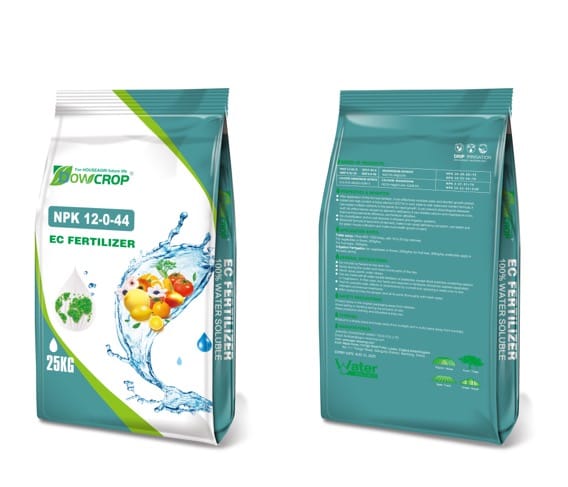
Potassium Nitrate 12.0.44
Product Description
Our provided Potassium Nitrate-B+ (12-0-44) is a crystalline/powder fertilizer with a high degree of purity and solubility, this formula specially with Boron, it helps to correct boron Nutrient deficiency, and effectively improve fruit setting and prevent flower and fruit abortion.
Free of chloride, sodium and any other harmful elements for the plant. This product is specially suitable for the middle and late stage of the life cycle of crops that require Potassium , micro elements.
The use of this product enables to obtain quantitatively and qualitatively high productions with a more intense coloring and a higher sugar, flavor and aroma content. It also increases the plants' resistance to environmental stress conditions.
Potassium nitrate (KNO3) is a soluble source of two major essential plant nutrients. It’s commonly used as a fertilizer for high-value crops that benefit from nitrate (NO3) nutrition and a source of potassium (K+) free of chloride (Cl). Production
Manufacturers typically make potassium nitrate fertilizer (sometimes referred to as nitrate of potash or NOP by reacting potassium chloride (KCl) with a nitrate source. Depending on the objectives and available resources, the nitrate may come from sodium nitrate, nitric acid or ammonium nitrate. The resulting KNO3 is identical regardless of the manufacturing process. Potassium nitrate is commonly sold as a water-soluble, crystalline material primarily intended for dissolving and applying with water or in a prilled form for soil application. Traditionally, this compound is known as saltpeter.
Chemical Properties
Chemical Formula: KNO3
N Contents: 13%
K2O Content: 44 to 46%
Water Solubility (20oC)316 g/L
Solution pH 7 to 10 Uses in Agriculture
Our value fertilizing with KNO₃ especially in conditions where a highly soluble, chloride-free nutrient source is needed. In such soils, all of the N is immediately available for plant uptake as nitrate, requiring no additional microbial action and soil transformation. Potassium nitrate contains a relatively high proportion of K, with an N to K ratio of approximately one to three. Many crops have high K demands and can remove as much or more K than N at harvest.
Applications of KNO₃ to the soil are made before the growing season or as a supplement during the growing season. A diluted solution is sometimes sprayed on plant foliage to stimulate physiological processes or to overcome nutrient deficiencies. Foliar application of K during fruit development advantages some crops, since this growth stage often coincides with high K demands during the time of declining root activity and nutrient uptake. It’s also commonly used for greenhouse plant production and hydroponic culture.
Both N and K are required by plants to support harvest quality, protein formation, disease resistance and water-use efficiency. Therefore, to support healthy growth, farmers often apply KNO₃ to soil or through the irrigation system during the growing season.
Potassium nitrate accounts for only a small portion of the global K fertilizer market. It’s primarily used where its unique composition and properties can provide specific benefits to growers. Further, it’s easy to handle and apply, and is compatible with many other fertilizers, including specialty fertilizers for many high-value specialty crops, as well as those used on grain and fiber crops.
The relatively high solubility of KNO₃ under warm conditions allows for a more concentrated solution than for other common K fertilizers. However, farmers must carefully manage the water to keep the nitrate from moving below the root zone.
Potassium nitrate is an outstanding source of potassium because of its nutritional value and its contribution to plant health and yield. Potassium nitrite increases yields and betters the quality of horticulture crops, flowers, fruit trees and nuts. Potassium nitrate contributes to the nutrition efficiency of crops.
Potassium nitrate is absorbed efficiently. The synergic effect between K+ and NO3- facilitates the absorption of both nutrients through the plant’s roots. In addition, the affinity between the negative charge of nitrate and the positive charge of potassium diminishes the possibilities of absorbing soil particulates, thereby making them available to the plants for a longer period.
Potassium nitrate for healthier and stronger plants
Potassium nitrate is not toxic to the roots of the plants. Unlike ammonia, the nitric nitrogen which is present in potassium nitrate does not destroy plant roots at elevated soil temperatures.
Potassium nitrate increases frost tolerance. The potassium present in potassium nitrate helps to construct thicker cell walls, and increase the level of electrolytes in the cells, which, in turn, increases the plant’s resistance to frost.
Potassium nitrate increases plant’s resistance to pathologies. It eliminates the accumulation of short-chain carbohydrates and non-protein nitrogen, which acts as a line of defense against bacteria, fungi, nematodes and viruses.
Potassium nitrate makes plants more drought-tolerant, favors the initiation and ramification of the root system and improves better water absorption in the soil.
Potassium nitrate for higher yields
Potassium nitrate has positive effects in the following quality parameters: Fruit caliber: Larger dimensions and an increase in uniformity. Fruit appearance: Better, more even colored fruit, reducing color defects or unusual spots caused by mechanical lesions or any other sign of pathology to a minimum. Potassium Nitrate 12.0.44
Potassium Nitrate 12.0.44 is available at AK Industry Pakistan which is one of the largest industry engaged in Agro Textile and Tunnel farming promoting for the last 2 decades. We are a recognized distributer of DOW CROP UK in Pakistan.
We Deliver this product from Pakistan to nationwide and internationally. We deliver by air and by sea shipment.
We fulfill minor and Major order on priority. Order Now
We accept Western Union, Moneygram, TT, LC and wire transfer.
Packing: 25kg Durable bag
Inquiry:
info@akindustrygroup.com
+92 333 3333 588